

Germany Leads Automotive Lightweight Materials Shift, Backed by ArcelorMittal, BASF & Asahi Kasei
EV expansion, stringent EU emissions mandates, and engineering innovation accelerate Germany’s dominance in next-generation lightweight automotive materials
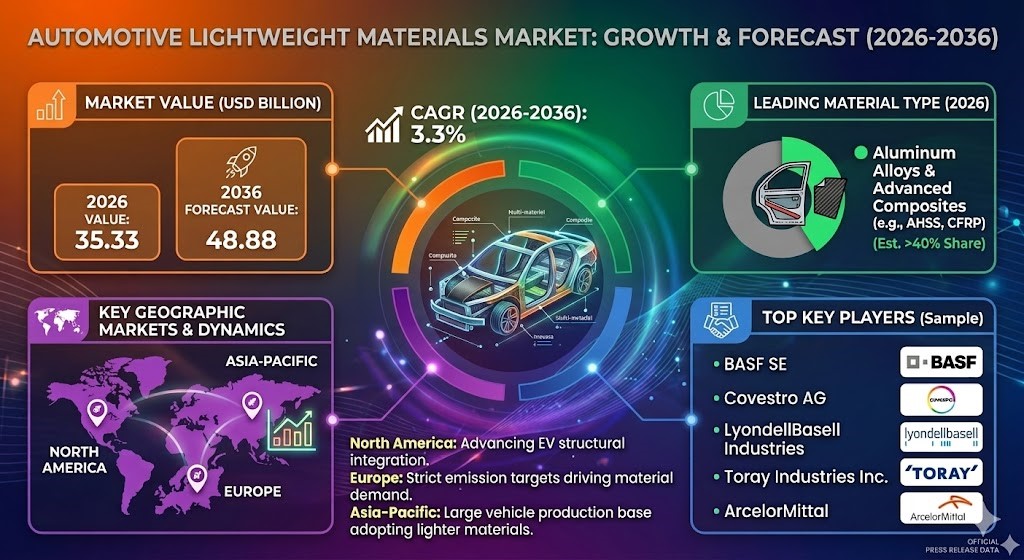
ROCKVILLE, MD, UNITED STATES, April 10, 2026 /EINPresswire.com/ -- According to Fact.MR’s latest analysis, the automotive lightweight material market in Germany is emerging as a strategic cornerstone within the global industry, which is valued at USD 35.33 billion in 2026 and projected to reach USD 48.88 billion by 2036, growing at a CAGR of 3.3%. Germany itself is forecast to expand at a 3.2% CAGR during the same period, driven by its leadership in automotive engineering and rapid transition toward electric mobility.From USD 34.2 billion in 2025, the global market is witnessing an incremental opportunity of USD 13.55 billion, with Germany capturing a significant share due to its advanced OEM ecosystem and regulatory-driven innovation. The shift toward multi-material vehicle architectures—combining aluminum, advanced high-strength steel (AHSS), and composites—is redefining vehicle design and manufacturing across the country.
Get detailed market forecasts, competitive benchmarking, and pricing trends: https://www.factmr.com/connectus/sample?flag=S&rep_id=3423
Quick Stats
Global Market Size (2026): USD 35.33 Billion
Global Market Size (2025): USD 34.2 Billion
Forecast Value (2036): USD 48.88 Billion
CAGR (2026–2036): 3.3%
Germany CAGR: 3.2%
Incremental Opportunity: USD 13.55 Billion
Leading Segment: Metals (52.0% share)
Leading Vehicle Type: Passenger Cars (68.0% share)
Top Application: Exterior & Structural (42.0% share)
Key Players: ArcelorMittal, BASF, Asahi Kasei, AK Steel, Aleris
Executive Insight for Decision Makers
Germany’s automotive sector is transitioning from traditional material usage to multi-material engineering platforms, where weight optimization is critical for compliance and performance.
Strategic Priorities:
Accelerate adoption of lightweight materials in EV platforms
Invest in advanced forming and joining technologies
Strengthen partnerships between OEMs and material suppliers
Risk Factors:
Delayed adoption may result in EU regulatory penalties
Competitive disadvantage in EV range and efficiency benchmarks
Market Dynamics
Key Growth Drivers:
Strict EU CO₂ emission standards pushing lightweight adoption
Rapid growth of EV production across Germany
Strong R&D ecosystem in automotive and material science
Increasing demand for fuel-efficient and high-performance vehicles
Key Restraints:
High production costs of composites and specialty materials
Complex manufacturing processes and tooling requirements
Volatility in raw material pricing
Emerging Trends:
Shift toward multi-material vehicle architectures
Rising use of recyclable and sustainable materials
Integration of automation and AI in material processing
Increased focus on lightweighting for battery efficiency
Segment Analysis
Leading Segment: Metals (52.0% share), driven by aluminum and AHSS
Fastest-Growing Segment: Aluminum (CAGR ~6.5%) due to EV demand
Vehicle Segment Leader: Passenger cars (68.0% share; CAGR 5.4%)
Top Application: Exterior & structural components (42.0% share; CAGR 7.1%)
Strategic Importance:
Structural applications directly impact vehicle safety and emissions
Lightweight materials are essential for extending EV range and performance
Supply Chain Analysis
Raw Material Suppliers:
Global suppliers of aluminum, steel, and carbon fiber provide foundational inputs, influenced by commodity cycles and sustainability mandates.
Material Processors:
Industry leaders such as ArcelorMittal and BASF convert raw materials into automotive-grade solutions including AHSS, polymers, and coatings.
Tier-One Suppliers:
Integrate materials into components like body structures, closures, and interiors.
OEMs (End-Users):
German automakers deploy these materials in passenger cars, EVs, and performance vehicles.
Value Chain Flow:
Raw materials → Processed materials → Component manufacturing → Vehicle assembly → End consumers
Germany’s integrated supply chain enhances innovation speed, quality control, and scalability.
Pricing Trends
Commodity vs Premium:
Steel and aluminum: Semi-commodity pricing
Carbon fiber and composites: Premium pricing
Key Influencers:
Raw material costs and energy prices
Certification and regulatory compliance
Demand from EV manufacturers
Margin Insights:
Higher margins in advanced composites and specialty materials
Cost pressures due to input price volatility
Regional Analysis (Germany Focus)
Germany ranks among the top-performing developed markets with a 3.2% CAGR, supported by:
Strong automotive manufacturing base
Leadership in EV and hybrid vehicle production
Advanced R&D infrastructure
Strict environmental regulations
Comparison:
Developed markets like Germany emphasize innovation and compliance
Emerging markets focus on volume expansion and cost efficiency
Competitive Landscape
Market Structure: Moderately consolidated
Key Players:
ArcelorMittal
BASF
Asahi Kasei
AK Steel
Aleris International
Baoshan Iron & Steel
Braskem
Strategies:
Investment in R&D and innovation
Strategic OEM partnerships
Expansion of localized production facilities
Focus on sustainable material solutions
Strategic Takeaways
For Manufacturers:
Invest in automotive-grade lightweight material production
Enhance capabilities in multi-material integration
For Investors:
Focus on companies aligned with EV and sustainability trends
Target high-growth segments like aluminum and composites
For Distributors:
Strengthen OEM relationships
Offer customized, high-performance material solutions
Future Outlook
Germany will continue to lead innovation in automotive lightweight materials through:
Development of next-generation alloys and composites
Adoption of carbon-neutral manufacturing processes
Expansion of electric vehicle infrastructure
The long-term opportunity lies in sustainable lightweight solutions that align with global decarbonization goals.
Conclusion
Germany’s automotive lightweight material market is positioned at the intersection of regulation, innovation, and electrification. Companies that proactively invest in advanced materials and scalable technologies will capture long-term value in this evolving landscape.
Why This Market Matters
As the automotive industry transitions toward electrification and sustainability, lightweight materials are becoming a critical enabler of efficiency, compliance, and performance. Germany’s leadership in this space underscores its pivotal role in shaping the future of global mobility.
Unlock 360° insights for strategic decision making and investment planning: https://www.factmr.com/checkout/3423
To View Related Report:
Automotive Smart Display Market https://www.factmr.com/report/251/automotive-smart-display-market
Low Voltage Motors Market https://www.factmr.com/report/256/low-voltage-motors-market
Railcar Leasing Market https://www.factmr.com/report/264/railcars-leasing-market
Automotive Cabin Air Filter Market https://www.factmr.com/report/266/automotive-cabin-air-filter-market
About Fact.MR
Fact.MR is a global market research and consulting firm, trusted by Fortune 500 companies and emerging businesses for reliable insights and strategic intelligence. With a presence across the U.S., UK, India, and Dubai, we deliver data-driven research and tailored consulting solutions across 30+ industries and 1,000+ markets. Backed by deep expertise and advanced analytics, Fact.MR helps organizations uncover opportunities, reduce risks, and make informed decisions for sustainable growth.
S. N. Jha
Fact.MR
+ +1 628-251-1583
sales@factmr.com
Legal Disclaimer:
EIN Presswire provides this news content "as is" without warranty of any kind. We do not accept any responsibility or liability for the accuracy, content, images, videos, licenses, completeness, legality, or reliability of the information contained in this article. If you have any complaints or copyright issues related to this article, kindly contact the author above.
