

AndaSeat Pre-Black Friday Campaign Examines How Monitor Arms Are Changing Device-Dense Workstations
Monitor Arm Series + Xtreme Desk
Monitor Arm Series + Xtreme Desk
Monitor Arm Series + Xtreme Desk
AndaSeat Pre-Black Friday Campaign Examines How Monitor Arms Are Changing Device-Dense Workstations
SPOKANE, WA, UNITED STATES, October 13, 2026 /EINPresswire.com/ -- As part of its 2026 Pre-Black Friday campaign, AndaSeat is highlighting its Monitor Arm Series together with the Xtreme Series standing desk against a changing workstation landscape in which multiple displays, laptops, chargers and peripherals increasingly need to coexist within one physical setup.A 2026 study published in the International Journal of Industrial Ergonomics examined the growing use of multi-monitor workstations through a literature review and a survey of 208 computer users. Approximately 65% of respondents reported using multiple monitors, while dual-monitor configurations accounted for roughly 71% of the multi-monitor group. The researchers found that screen number, layout, size and task type all influenced the experience of using multiple displays, while current ergonomic guidance has not fully kept pace with newer workstation configurations.
The shift creates a more specific design problem than simply adding more desktop space. A workstation may need to support several screens and devices, but each component still requires an appropriate position relative to the user. The monitor must remain at a suitable height and viewing distance, the keyboard and mouse need an accessible work zone, and power and display cables must move without forcing the entire setup into one fixed arrangement.
AndaSeat is positioning the Monitor Arm Series and Xtreme desk as two complementary layers within that increasingly complex system.
Multi-Screen Work Changes the Geometry of the Desk
A single-monitor workstation can often be organized around one relatively stable center line. Once a laptop, second display or larger monitor is added, the geometry becomes more complicated. The primary screen may need to remain directly in front of the user, while secondary displays must sit close enough to limit excessive head and neck movement. Desk depth also becomes more important because larger displays and conventional monitor stands can push the screen closer to the user or consume space needed for input devices.
Current OSHA computer-workstation guidance reflects these concerns. It recommends sufficient monitor adjustability for height, viewing distance and tilt, and notes that multi-monitor users should keep the primary screen directly in front while positioning other displays nearby. OSHA also advises providing enough work-surface depth to maintain an appropriate viewing distance and enough clearance when several screens are used.
The issue therefore is not simply that more screens occupy more space. It is that every additional display changes the relationship among the screen, user and work surface. A monitor arm becomes valuable when it separates those variables rather than forcing screen placement to depend on the shape and footprint of the original monitor base.
Monitor Arm Creates an Independent Screen Layer
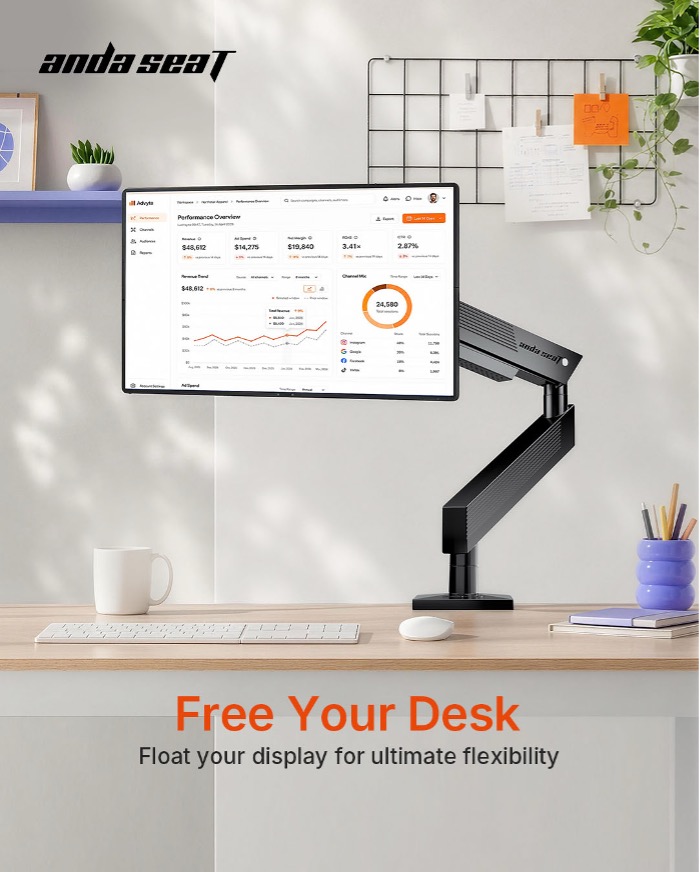
The AndaSeat Monitor Arm Series is designed to move display positioning away from the fixed geometry of the desktop. By mounting the monitor from the rear of the work surface, the system removes the original monitor stand from the active desk area and allows screen height, distance, tilt and orientation to be adjusted independently.
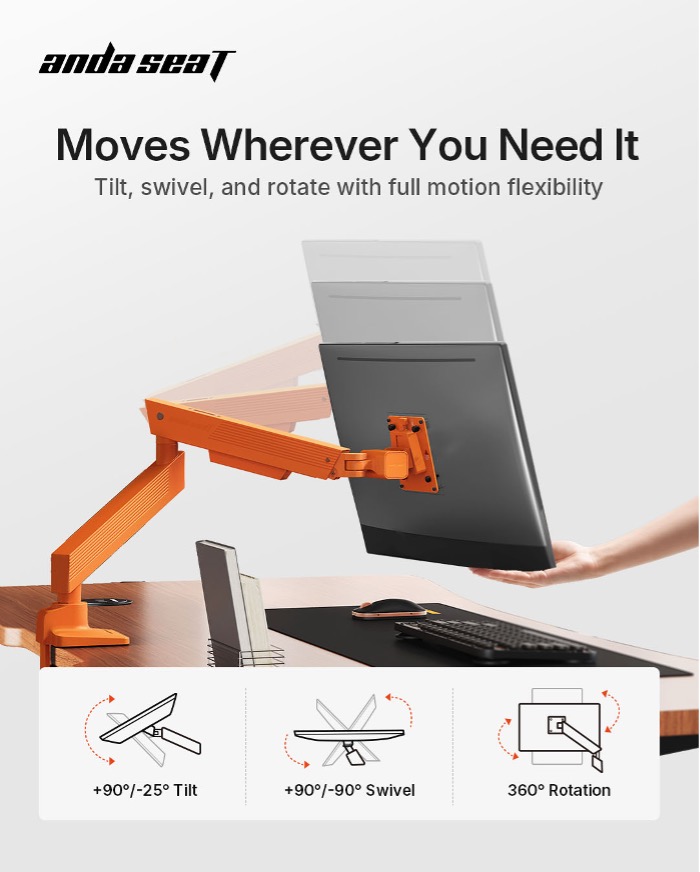
The arm supports monitors from 17 to 34 inches and loads from 3 to 11 kg, together with 75 × 75 mm and 100 × 100 mm VESA mounting patterns. Its motion range includes tilt from -25 degrees to +90 degrees, swivel from -90 degrees to +90 degrees and 360-degree screen rotation. A mechanical spring structure manages larger positioning changes, while the one-way bearing head joint is designed to help the screen remain at the selected angle after adjustment.
This independent screen layer becomes more relevant as users move among different display configurations. A monitor may need to sit farther away when a larger screen is installed, rotate into portrait orientation for documents or communication feeds, or move closer during detailed creative work. Rather than changing the entire desk position to accommodate those differences, the arm allows the display itself to respond.
The same principle also helps recover usable surface area. Removing the original monitor base creates additional room for a laptop, keyboard, tablet, notebook or other equipment without enlarging the desk itself.
Xtreme Provides the Work-Surface and Infrastructure Layer
While the Monitor Arm manages the display, Xtreme manages the surface supporting the rest of the workstation.
The desk provides electric height adjustment from 28.7 to 46.1 inches, allowing keyboards, mice, laptops and other desktop equipment to move together as one working level. Three memory presets allow frequently used heights to be stored, while the digital control panel provides real-time height information together with anti-collision and child-lock functions.
This separation matters because monitor height and work-surface height are related but not identical. Moving the entire desk changes the position of every object at once, while the Monitor Arm can then refine the display independently. The result is a system in which the keyboard and mouse can remain aligned with the working surface while the screen receives its own final positioning adjustment.
Xtreme also provides the structural base needed for a device-heavy setup. Its cold-formed steel T-frame incorporates dual support beams, extended side brackets, reinforced legs and wide feet, with a stated load capacity of up to 70 kg including the desktop. The purpose of this structure is not simply to support weight, but to preserve the relationship among several pieces of equipment while the surface changes height.
Cable Management Becomes a Two-Level System
Multiple displays and peripherals create another workstation problem that cannot be solved through screen positioning alone: cables must travel through both the moving display layer and the desk infrastructure beneath it.
The Monitor Arm Series uses magnetic cable covers along the arm to route monitor power, HDMI, DisplayPort and USB connections while retaining access when cables need to be replaced or rearranged. The covers are removable, allowing the cable path to change as the monitor configuration evolves rather than becoming permanently sealed after the first installation.
Xtreme manages the lower portion of the same system. The desk routes its primary wiring through one leg and provides an under-desk steel cable tray for power strips and excess cable length. This creates a defined path from the floor and power source to the desk, while the Monitor Arm manages the final movement between the desk and display.
The distinction is increasingly important in height-adjustable workstations because two forms of motion occur simultaneously. The desk travels vertically, while the monitor arm can extend, retract, rotate and change height above the surface. Cable management therefore becomes less about hiding wires and more about allowing different components to move without the cable path becoming the limiting factor.
Monitor Arms Are Becoming Part of Workstation Architecture
The rise of multi-monitor setups suggests that the screen can no longer be treated as a passive object placed on top of a desk. The 2026 multi-monitor study found substantial variation in the number, size and arrangement of screens people use, while also identifying gaps in practical ergonomic guidance for newer configurations.
This shift changes the role of both the monitor arm and the desk. The monitor arm becomes the screen-positioning structure, while the desk becomes the foundation supporting input devices, power routing and equipment movement. Each system controls a different part of the workstation instead of requiring one static arrangement to satisfy every device.
For AndaSeat, the Monitor Arm Series and Xtreme desk reflect that layered approach. The Monitor Arm creates freedom around screen height, distance and orientation. Xtreme controls the work-surface level, structural stability and lower cable infrastructure. Together, they address a workstation that is increasingly defined not by one computer and one display, but by a network of devices that need to remain independently manageable.
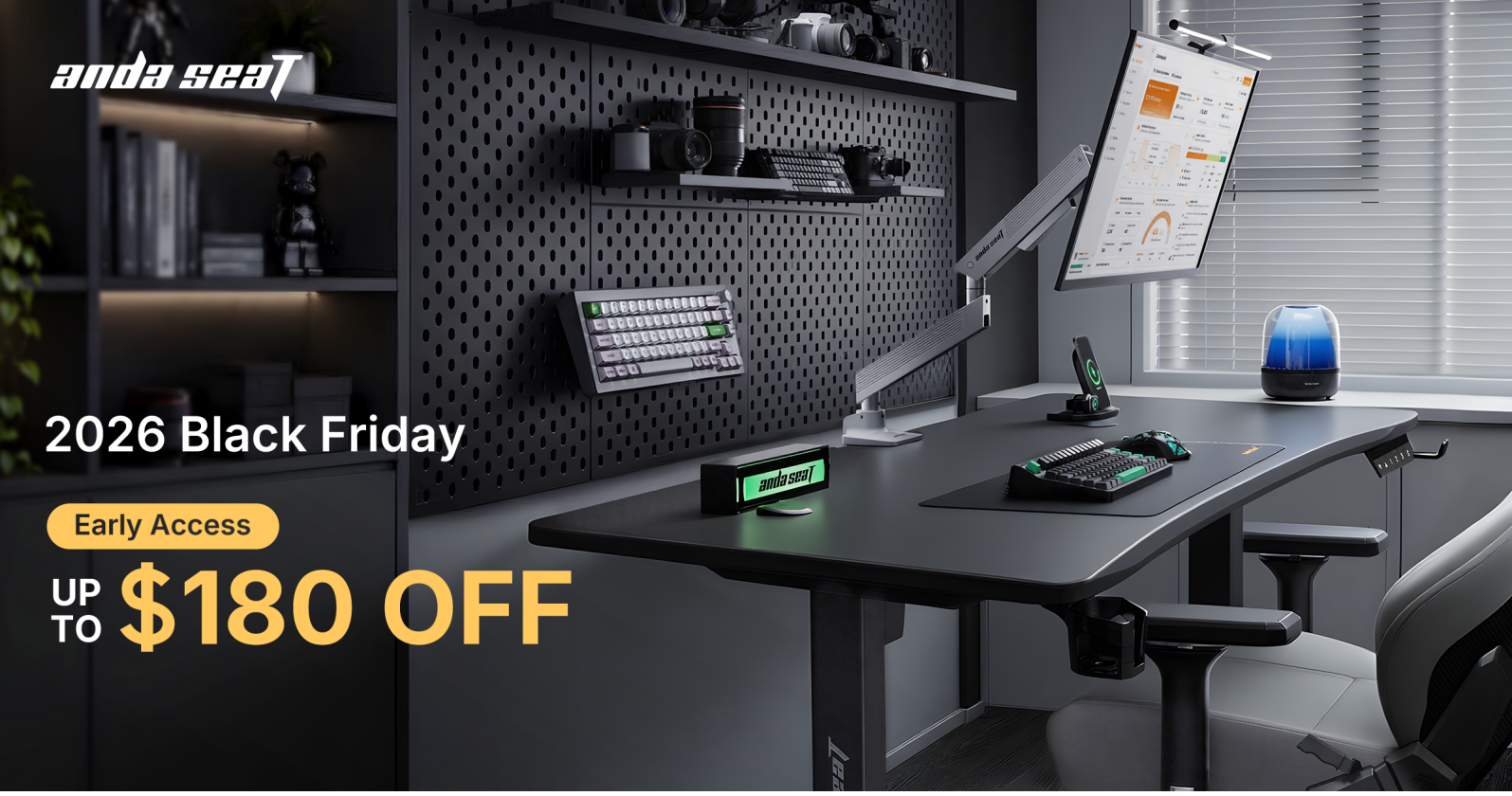
The company’s Pre-Black Friday campaign includes selected workspace products, with campaign availability and applicable conditions varying by market.
About AndaSeat
Founded in 2007, AndaSeat develops ergonomic furniture and workspace products for gaming, professional and home environments. Its portfolio includes ergonomic chairs, standing desks, monitor arms and related workspace accessories. AndaSeat’s product-development approach combines structural engineering, adjustable ergonomics, equipment management and workspace design around the changing ways people interact with computers, displays and digital devices.
AndaSeat Marketing
AndaSeat
+ +86 139 2232 2347
email us here
Visit us on social media:
LinkedIn
Instagram
Facebook
YouTube
TikTok
X
Legal Disclaimer:
EIN Presswire provides this news content "as is" without warranty of any kind. We do not accept any responsibility or liability for the accuracy, content, images, videos, licenses, completeness, legality, or reliability of the information contained in this article. If you have any complaints or copyright issues related to this article, kindly contact the author above.
